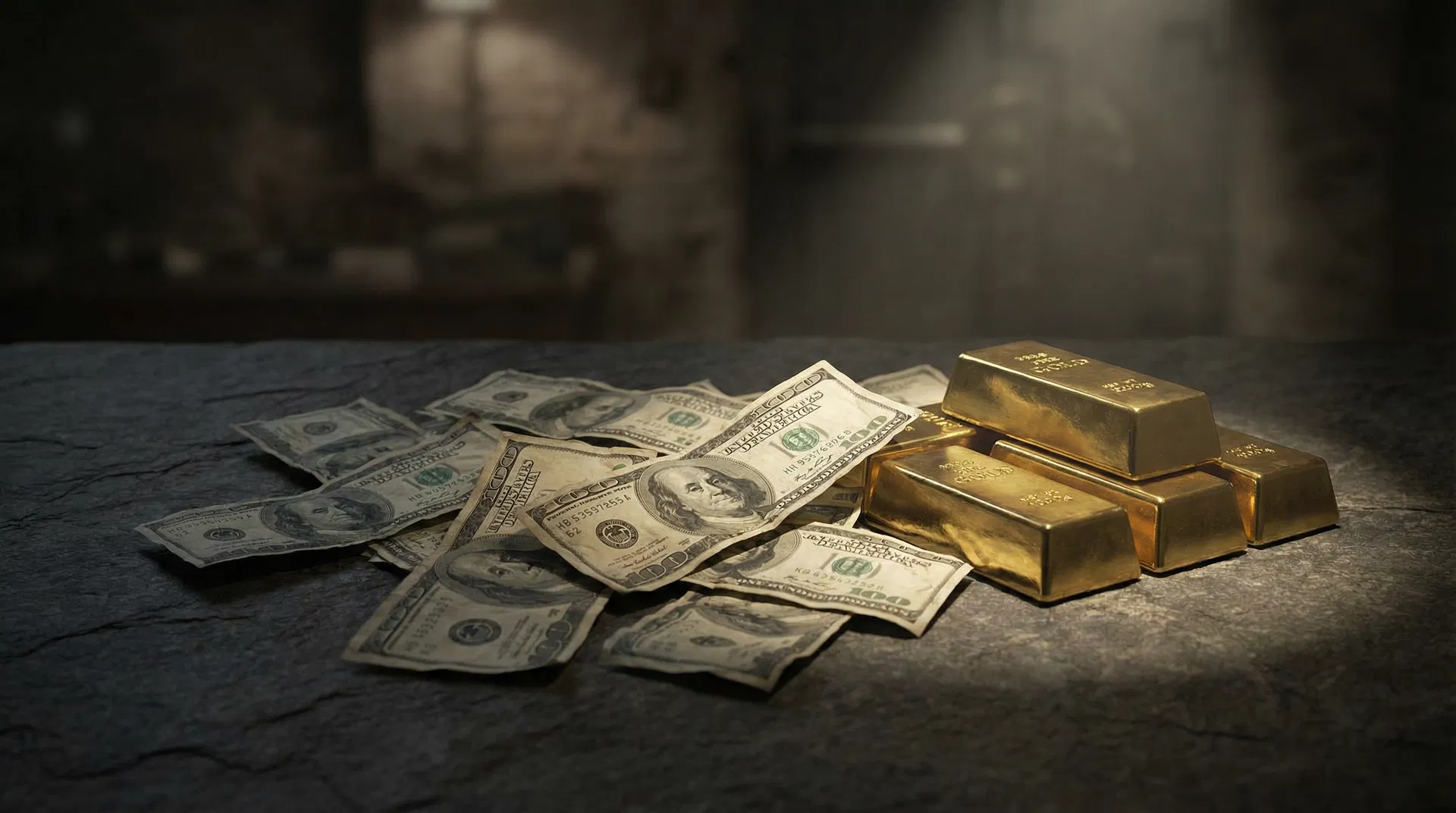
It used to be a fringe conversation — something whispered by survivalists and gold bugs on the economic margins. "What happens when the dollar collapses?"
Today, it's a front-page question asked by J.P. Morgan, Bank of America, Morningstar, and central banks representing over 100 countries. Because here's what most people don't yet know: a seismic shift has already begun. And if your savings are entirely in dollar-denominated assets, the window to act may be narrower than you think.
This isn't fear-mongering. This is a data-driven look at what's happening right now — and more importantly, what history tells us to do about it.
Part 1: What Does "Dollar Collapse" Actually Mean?
Let's be precise, because this phrase gets misused constantly.
A full, overnight dollar collapse — the kind where your $20 bill buys nothing tomorrow morning — is not what's happening. Most credible economists don't believe that scenario is imminent. The dollar still dominates approximately 57% of global foreign exchange reserves and appears on one side of nearly 89% of all global FX trades.
Whatishappening, however, is arguably more significant over the long run:a slow, structural erosion of the dollar's dominance— driven by factors that are accelerating, not slowing down.
Think of it less like a cliff and more like a glacier melting. It's happening steadily, persistently, and the consequences compound over time. For your retirement savings, your IRA, your home equity — a 20–30% reduction in dollar purchasing power over a decade is every bit as devastating as a dramatic crash. It just hurts you more quietly.
Part 2: The Warning Signs Are Flashing Red in 2026
Here's the part that should command your full attention: the indicators that monetary historians use to spot reserve currency erosion are all moving in the same direction at the same time.
The Dollar Index Is Trending Down
The U.S. Dollar Index (DXY), which measures the dollar against a basket of major currencies, fell nearly 10% through 2025 — its worst performance in nearly a decade. Against the euro, it declined over 13%. Against the Swiss franc, nearly 14%. Morgan Stanley analysts projected the greenback could lose another 10% by late 2026. These aren't rounding errors. These are structural moves.
Gold Has Officially Overtaken the Dollar as the World's #1 Reserve Asset
In a development that made international financial headlines in early 2026, gold surpassed U.S. Treasury bonds as the world's largest foreign reserve asset held by central banks — for the first time since 1996. According to World Gold Council data, foreign central banks now hold approximately$6 trillion worth of gold(around 36,000 tonnes), compared to roughly $3.9 trillion in U.S. Treasuries. That crossover is not a coincidence. It is a deliberate, coordinated act of institutional repositioning.
Central Banks Are Buying Gold at Record Pace
Global central banks purchased over 1,000 tonnes of gold in 2025 — the third consecutive year above that threshold, and more than double the pre-2022 average of 400–500 tonnes annually. Major buyers include China, India, Poland, Turkey, Brazil, and an array of Middle Eastern and BRICS-aligned nations. These aren't retail investors spooked by a headline. These are the world's most sophisticated financial institutions making long-term strategic bets — and they are betting on gold, not the dollar.
As J.P. Morgan noted in its own research:"Increased polarization in the U.S. could jeopardize its governance, which underpins its role as a global safe haven."
The National Debt Problem Has No Easy Fix
The U.S. national debt has surpassed $38 trillion. The Congressional Budget Office's long-run projections show large, persistent deficits with no realistic path to resolution without either significant spending cuts, tax increases, or — most likely — continued monetary expansion (i.e., printing money). Each new dollar created dilutes the purchasing power of every existing dollar. This is the slow leak in the tire that most Americans never notice until they're stranded on the side of the road.
The Fed's Rate Cut Cycle Is a Headwind for the Dollar
Lower interest rates reduce the yield advantage of holding dollar-denominated assets. As the Federal Reserve continues its rate-cutting cycle, global investors are increasingly seeking better returns elsewhere — a dynamic that structurally weakens demand for the dollar. The Fed's credibility is also under unusual scrutiny heading into May 2026, when Fed Chair Jerome Powell's term expires and political pressure on the central bank's independence has intensified.
Part 3: What History Tells Us to Own
Every major currency devaluation and reserve currency transition in modern history has followed a recognizable pattern. And in every case, a small group of informed investors preserved — and even grew — their wealth, while the unprepared majority watched their purchasing power erode.
Here's what history consistently shows works:
1. Physical Gold — The Ultimate Monetary Anchor
Gold has served as a store of value for over 5,000 years across every civilization, every empire, and every currency system. It has survived the fall of Rome, the Weimar hyperinflation, the collapse of Bretton Woods, the 2008 financial crisis, and the COVID monetary shock. It cannot be printed. It cannot be sanctioned. It cannot default. It carries no counterparty risk.
Gold ended 2025 with a gain of nearly 70%, crossed $4,500 per ounce in early 2026, and major institutions including Bank of America are now projecting prices could reach $5,000 per ounce or higher by year-end. The gold-dollar inverse relationship remains one of the most reliable dynamics in global markets: when the dollar weakens, gold strengthens.
Veteran hedge fund manager David Einhorn stated plainly in early 2026 that gold is "becoming the reserve asset" — a view that was once contrarian but is now increasingly mainstream across Wall Street.
2. Silver — Gold's Undervalued Sibling
Silver carries many of the same monetary properties as gold while also benefiting from massive and growing industrial demand — particularly in solar panel manufacturing, electric vehicles, and semiconductor production. Analysts at Bank of America project silver could reach $65 per ounce by late 2026. Given that silver has historically lagged gold's gains before catching up sharply, many investors who can't access gold at its current prices are finding silver to be a compelling entry point.
3. A Diversified Hard-Asset Portfolio for Modern Times
The classic 60/40 (stocks/bonds) portfolio has shown significant cracks. Bonds, once considered the reliable counterweight to stock volatility, have underperformed for over a decade as inflation has eroded real returns. A growing number of investment strategists are now advocating for what might be called the4-Asset Class Portfolio: approximately 50% equities, 25% bonds, 20% physical gold or precious metals, and 5% cash. The logic is straightforward: gold fills the gap left by bonds that no longer reliably provide stability.
4. Tax-Advantaged Precious Metals Through a Gold IRA
One of the most powerful and underutilized tools available to American investors is theGold IRA— a self-directed individual retirement account that holds IRS-approved physical gold, silver, platinum, or palladium instead of (or in addition to) paper assets. A Gold IRA allows you to protect retirement savings from inflation and dollar devaluation while maintaining the same tax advantages as a conventional IRA or 401(k). You can roll over an existing IRA or 401(k) into a Gold IRA without triggering a taxable event.
Part 4: The Critical Difference Between Paper Gold and Physical Gold
Before moving forward, it's worth clarifying a distinction that most financial advisors gloss over — and that distinction can mean the difference between real protection and a false sense of security.
Paper gold— inc