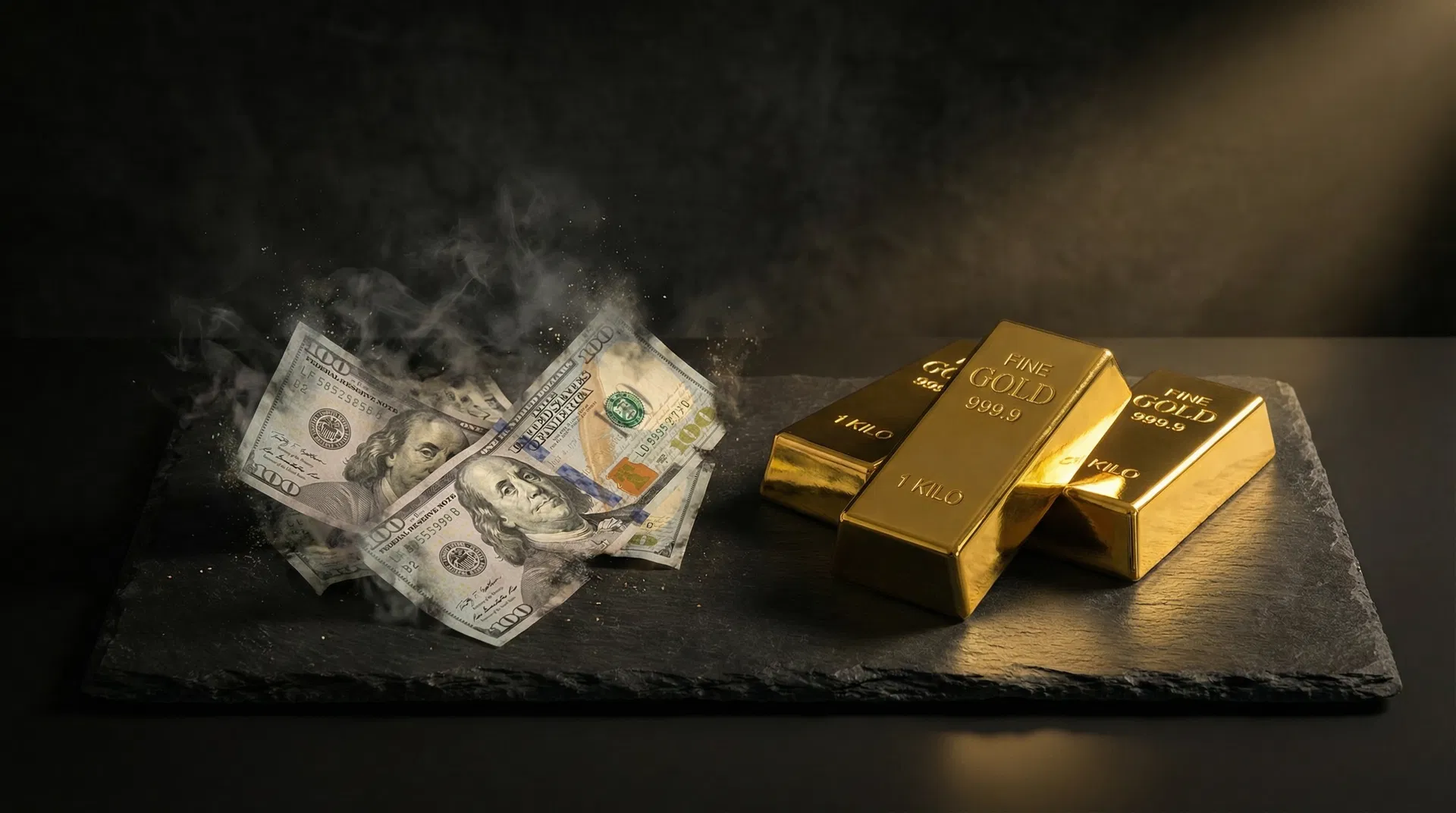
Most people think holding more cash means more safety.But in an inflationary environment, the opposite can be true.
Inflation doesn’t make loud announcements. It doesn’t send alerts. It doesn’t cause market crashes or headlines that spark panic. Instead, it quietly erodes the value of every dollar you hold — day after day, month after month.
The danger isn’t dramatic.It’ssilent.
In this guide, we break down exactlywhy holding too much cash becomes risky during inflation, how purchasing power decay works, and what investors can do to protect their wealth.
Inflation is often referred to as a“silent tax”because it reduces the real value of your money without ever touching your bank account directly.
If inflation is 7% and your savings account earns 1–2%, your purchasing power is shrinking by 5–6% every single year.
The number in your account stays the same.What itbuysdoes not.
- $20 today buys less food than it did a year ago
- $100,000 in savings buys fewer assets
- Retirement costs drift farther out of reach
Inflation punishes savers — especially those who hold large amounts of idle cash.
The Consumer Price Index (CPI) is designed to measure average price increases. But CPI doesnotreflect real-life inflation for most households.
Actual inflation often runs higher because:
- Food costs rise faster
- Rent and housing climb at double-digit rates
- Insurance costs surge
- Health care expenses rapidly outpace CPI
- Higher-income households experience “asset inflation” (homes, stocks, gold, etc.)
When the official inflation rate says 6%, day-to-day life may feel more like 10–15%.
This gap widens the hidden cost of holding cash.
Holding cash feels safe. It’s liquid, predictable, and accessible.
But inflation flips that logic:
- Cashguaranteespurchasing power loss
- Savings accounts rarely beat inflation
This is why economists say:
“Cash is great for emergencies — terrible for long-term savings.”
When inflation rises, your dollars today will buy significantly less five years from now — regardless of how much you’ve “saved.”
Gold behaves differently from cash because it is ahard asset with intrinsic value, not a currency that can be printed.
Throughout modern economic history:
- Inflation rises → gold rises
- Currency weakens → gold strengthens
- Debt expands → gold becomes a safe haven
- Global uncertainty increases → gold demand grows
Gold doesn’t just keep up with inflation — it oftenoutperformsduring high-inflation cycles.
- Gold’s supply grows extremely slowly
- It has global demand from individuals and central banks
- It holds real purchasing power across decades
- It cannot be devalued by government policy
While cash melts, gold holds.
$10,000 Held in Cash (10 Years of 3% Inflation Average):
Real value becomes roughly$7,400.
$10,000 Held During a 10-Year High-Inflation Cycle (6–8% Inflation):
Real value becomes roughly$4,600–$5,300.
You didn’t lose money on paper.But in the real world?You lost nearly half.
Contrast that with gold, which during past inflation cycles (1970s, early 2000s, 2020–2023) significantly outpaced CPI.
- Elevated inflation
- Rising global debt
- Currency volatility
- Declining confidence in fiat systems
- Aggressive central bank gold buying
… holding cash beyond short-term needs becomes increasingly risky.
Long-term savers need assets thatretain value, not just store digits.
Cash stores digits.Gold stores purchasing power.
Inflation doesn’t require panic — it requires preparation.
✔ Maintain an emergency cash cushion (3–6 months)
Cash has a purpose — liquidity.
✔ Reduce excess idle cash
Letting large amounts sit is the real risk.
✔ Diversify into hard assets
Gold and silver hedge against inflation’s long-term impact.
✔ Protect retirement accounts
Inflation accelerates the need for asset diversification inside IRAs and 401(k)s.
✔ Build a balanced, risk-aware strategy
Inflation is not a one-year event. It’s a decade-long force.
Inflation is not a headline.It’s not a trend.It’s not a one-time problem.
It is apermanent feature of modern monetary systems, and it continuously erodes the value of cash sitting idle.
While cash has its place, relying on it as a long-term store of value is one of the most expensive financial mistakes investors make.
Gold, on the other hand, is a timeless solution — a stable, global, inflation-resistant asset that protects purchasing power when currencies falter.
Inflation eats cash.Gold endures.