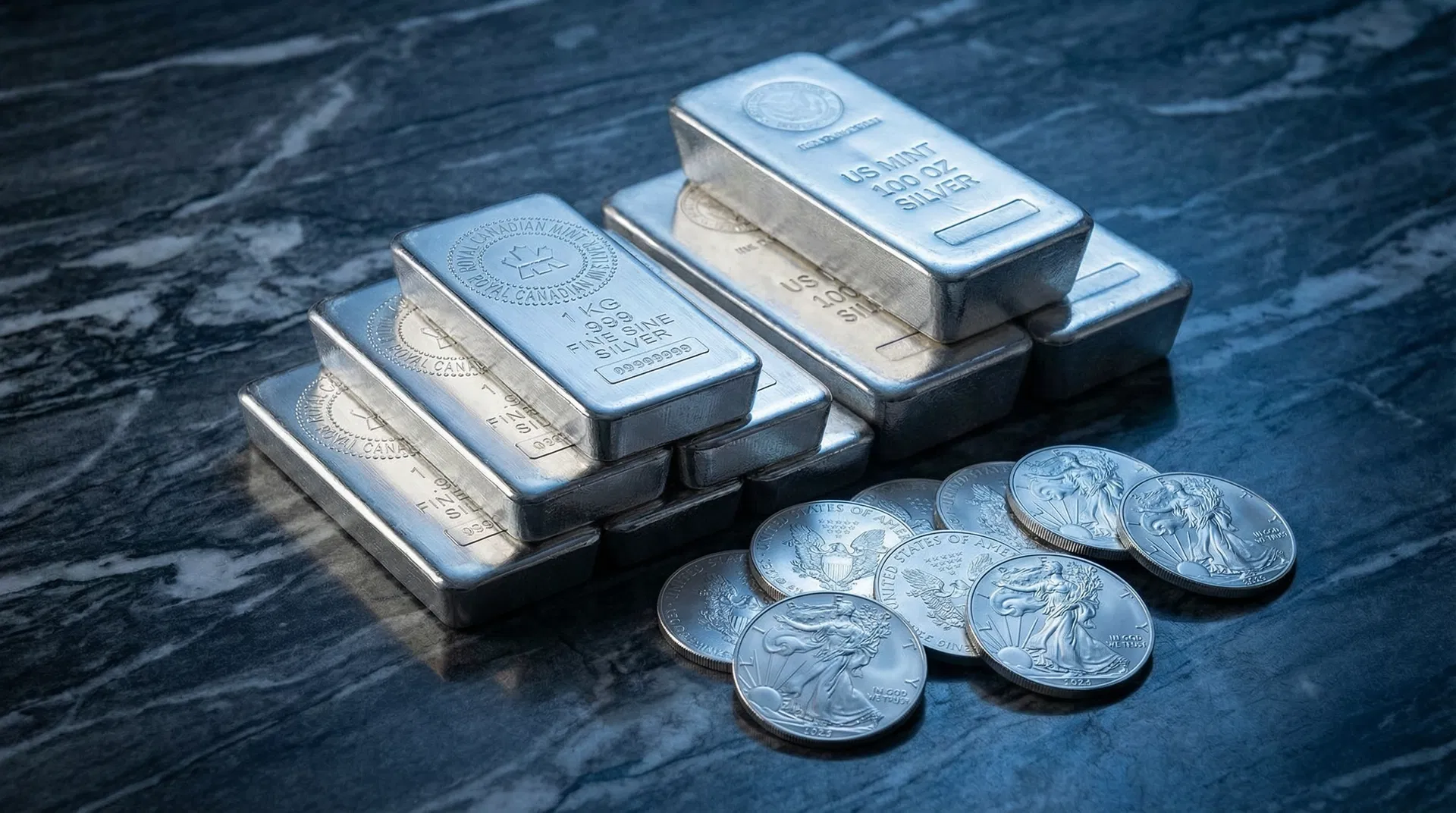

Silver has quietly turned into one of the most interesting stories in global markets.
In 2025, silver broke above $35 an ounce for the first time in over 13 years, logging gains of more than 20% by mid-year. It then spiked to around $54.50 on October 17, 2025—up roughly 72% over the prior year—before a sharp correction pulled prices back, though the metal remains more than 60% higher for 2025 overall.
So even with volatility and recent pullbacks, the big picture is clear: silver has been doing very well. The question is why—and whether the underlying drivers are short-term noise or part of a deeper structural shift.
Let’s break it down.
1. Silver’s “two-in-one” identity: money and critical industrial metal
Unlike gold, which is used mostly as a monetary metal and store of value, more than half of global silver demand now comes from industrial uses—electronics, solar panels, electric vehicles (EVs), medical devices, and more.
That dual identity matters:
-
When investors are nervous about inflation, currency debasement, or geopolitical risk, silver can behave like a traditional safe-haven alongside gold.
-
When the global economy is expanding, especially in technology and energy, silver behaves like a critical industrial commodity.
Right now, both sides of that identity are playing a role:
-
Industrial side: Silver is essential for the energy transition, AI infrastructure, and advanced electronics, which are all long-term structural growth themes.
-
Monetary side: Years of high inflation, heavy government debt, and shifting central bank policy have kept interest in real assets elevated.
That “two engines on one plane” effect is a big reason silver has been able to outperform at times and stage such powerful rallies.
2. Industrial demand is booming — especially from solar and electrification
The single biggest structural change in silver over the past decade is how much of it is now consumed by green and high-tech applications.
Some key facts:
-
Industrial uses made up about 59% of total silver demand by mid-2025, according to institutional research. Silver is now indispensable to solar panels, EVs, and consumer electronics.
-
The solar industry alone consumed roughly 197–232 million ounces of silver in 2024, accounting for about 19% of global silver demand, up from just ~5% in 2014.
-
Silver paste used in solar cells is often 60–90% silver by mass; over 85% of all silver paste demand comes from the solar industry.
-
The International Energy Agency projects around 4,000 gigawatts of new solar capacity by 2030, implying ongoing growth in silver consumption from photovoltaics.
-
EVs use roughly 2–3× more silver than traditional gas vehicles because of additional wiring, sensors, and power electronics.
Put simply:
Every solar panel, every EV, every data center and AI server farm quietly “eats” silver.
Even if silver investment demand were flat, these industrial trends alone would make a strong long-term case for the metal. The fact that they’re growing at the same time as investor interest is what makes the current environment so powerful.
3. Structural supply deficits: demand keeps beating supply
A commodity can only sustain a bullish move if its fundamentals back it up. In silver’s case, they do.
For multiple years in a row, the silver market has been in structural deficit—meaning total demand has exceeded total supply (mine production + recycling):
-
The Silver Institute and related research show a large deficit in 2023, with demand around 1.24 billion ounces against supply of about 1.01 billion ounces, leaving a shortfall of roughly 230 million ounces—one of the largest on record.
-
The 2024 deficit has been estimated around 215 million ounces, and 2024 marked the fourth consecutive year of structural market deficit, with a combined shortfall of about 678 million ounces between 2021 and 2024—equivalent to around ten months of global mine supply.
-
Industry estimates suggest 2025 is on track for a fifth straight year of deficit, even as some categories of demand soften.
What makes this especially important is how inelastic silver supply is:
-
Roughly 70%+ of silver production comes as a by-product of mining other metals like copper, lead, and zinc, not from dedicated “primary” silver mines.
-
That means higher silver prices alone don’t automatically create a surge in supply, because miners’ investment decisions are driven mainly by base-metal economics.
-
At the same time, above-ground inventories have been drawn down over the last decade to accommodate deficits.
The takeaway:
Silver isn’t just experiencing a speculative pop—it’s operating in an environment where chronic undersupply has been quietly eroding inventories for years.
That supply-demand imbalance is a major reason silver is doing so well over a multi-year horizon, even if the price chart looks wild month-to-month.
4. Macro backdrop: rates, the dollar, and safe-haven flows
Silver also responds to the broader macro environment—especially:
-
Real interest rates (interest rates after inflation)
-
The strength of the U.S. dollar
-
Investor fear or confidence
Several macro forces have recently helped silver:
-
Expectations of Federal Reserve rate cuts and softer real yields
-
During 2025, markets increasingly priced in multiple Fed rate cuts. Lower real yields reduce the “opportunity cost” of holding non-yielding assets like precious metals. This helped drive silver towards a 14-year high around $41.80 at one point in 2025.
-
-
A weaker or less dominant dollar at times
-
When the dollar softens, dollar-priced commodities like silver typically become cheaper for non-U.S. buyers, encouraging demand and supporting prices.
-
-
Safe-haven demand during periods of uncertainty
-
Geopolitical tensions, debt concerns, and inflationary pressures have all supported renewed interest in real assets. While gold typically gets the headlines, silver often benefits as a “high-beta” precious metal that can move further and faster when sentiment turns positive.
-
Of course, these forces cut both ways:
-
When real rates jump and the dollar rallies hard, silver can sell off sharply—as we’ve seen in recent corrections.
-
That volatility is part of silver’s personality; it’s often called the “devil’s metal” for a reason.
But over the last couple of years, on balance, the macro backdrop—especially the rotation toward real assets and the anticipation of looser policy—has been more supportive than not.
5. The gold–silver ratio and the “catch-up” trade
Another reason silver has done so well: for much of this cycle, it looked cheap relative to gold.
The gold–silver ratio (the number of ounces of silver it takes to buy one ounce of gold) is a classic gauge of relative value:
-
Historically, that ratio has often hovered somewhere in the 50–70 range over the long term (not a hard rule, but a useful guideline).
-
In recent years, it spiked above 100, meaning silver was extremely cheap compared to gold on a historical basis.
When the ratio is that stretched, many investors interpret it as:
“Either gold is too expensive, or silver is too cheap—or some combination of both.”
As more investors noticed:
-
Some shifted from gold into silver to capture relative value.
-
Others added silver alongside gold to increase upside potential during a precious metals bull market.
This “catch-up trade” has contributed to periods where silver has outpaced gold’s percentage gains, especially in 2025, even though gold itself has been strong.
6. Recognition as a strategic and “critical” metal
Policy and perception also matter.
Several governments and agencies have begun to classify silver as a critical or strategic material because of its role in:
-
Renewable energy (solar)
-
Electrification (EVs, grids)
-
Advanced electronics and data infrastructure
Reports in 2025 highlight that silver’s recent recognition as a “critical mineral” in some jurisdictions has sharpened investor focus on its strategic importance and long-term demand growth.
This recognition adds another layer to the investment thesis:
Silver isn’t just “gold’s little cousin” anymore—it’s increasingly viewed as the metal that powers the energy and technology transition.
That narrative resonates strongly with long-term investors, institutions, and even policymakers, reinforcing demand during pullbacks.
7. Why silver specifically is doing so well (vs. other assets)
Putting it all together, silver’s strong performance is the result of a convergence of factors:
-
Chronic supply deficits
-
Multiple consecutive years of demand outpacing supply have burned through inventories and tightened the market.
-
-
Explosive industrial demand growth
-
Solar, EVs, and high-tech electronics have turned silver into an indispensable industrial metal, not just a monetary one.
-
-
Supportive macro environment for real assets
-
Elevated inflation, concerns about fiscal sustainability, and expectations of lower real rates have bolstered investor interest in precious metals.
-
-
Relative undervaluation vs. gold
-
Historically extreme gold–silver ratios invited a catch-up move in silver as investors looked further down the metals complex for value and upside.
-
-
Strategic narrative and policy focus
-
As governments push toward decarbonization and digitalization, silver’s role as a “critical enabler” has become clearer, reinforcing long-term demand expectations.
-
Even after recent corrections, those structural drivers remain in place.
8. The caveat: silver is strong and volatile
It’s important to recognize that silver’s strength doesn’t mean a smooth ride.
Recent price action has shown that:
-
After soaring to around $54.50 per ounce in October 2025, silver dropped more than 13% in under two weeks, even while staying up more than 60% for the year.
-
News of weakening industrial demand or tighter monetary policy can trigger fast sell-offs, especially given silver’s smaller market and higher speculative participation.
In other words:
Silver can be fundamentally strong and experience sharp short-term declines.
For investors and advisors, that usually means:
-
Treating silver as part of a diversified allocation to real assets, not a single “all-in” bet.
-
Recognizing that time horizon matters: structural deficits and industrial trends play out over years, not days.
9. How people typically position silver in a portfolio
While everyone’s situation is different, investors often use silver in a few common ways:
-
Physical silver (bars and coins)
-
For those who want direct ownership of a tangible asset outside the financial system.
-
-
Silver-related retirement accounts (like Precious Metals IRAs)
-
For investors who want exposure to silver within tax-advantaged retirement structures, often alongside gold.
-
-
ETFs and exchange-traded products
-
For tactical exposure or easier rebalancing in brokerage accounts.
-
-
Mining stocks and royalty companies
-
For higher-risk, potentially higher-reward exposure tied to exploration and production.
-
The right mix depends on goals, risk tolerance, and time horizon—but the backdrop explaining why silver is doing so well is the same across all of those vehicles.
10. Bottom line
Silver is enjoying a powerful run because the fundamentals have shifted in its favor:
-
It’s no longer just a “cheaper gold.”
-
It’s a critical industrial metal at the heart of solar, EVs, electronics, and AI infrastructure.
-
It’s operating in a multi-year supply deficit while inventories are being drawn down.
-
It’s benefiting from a macro environment that still favors real assets and from a relative value case versus gold.
Even with pullbacks and scary headlines, those structural forces haven’t disappeared. They’re the reason silver has done so well—and why many analysts believe it could remain a compelling asset in the years ahead for investors who understand both its powerful upside and its inherent volatility.