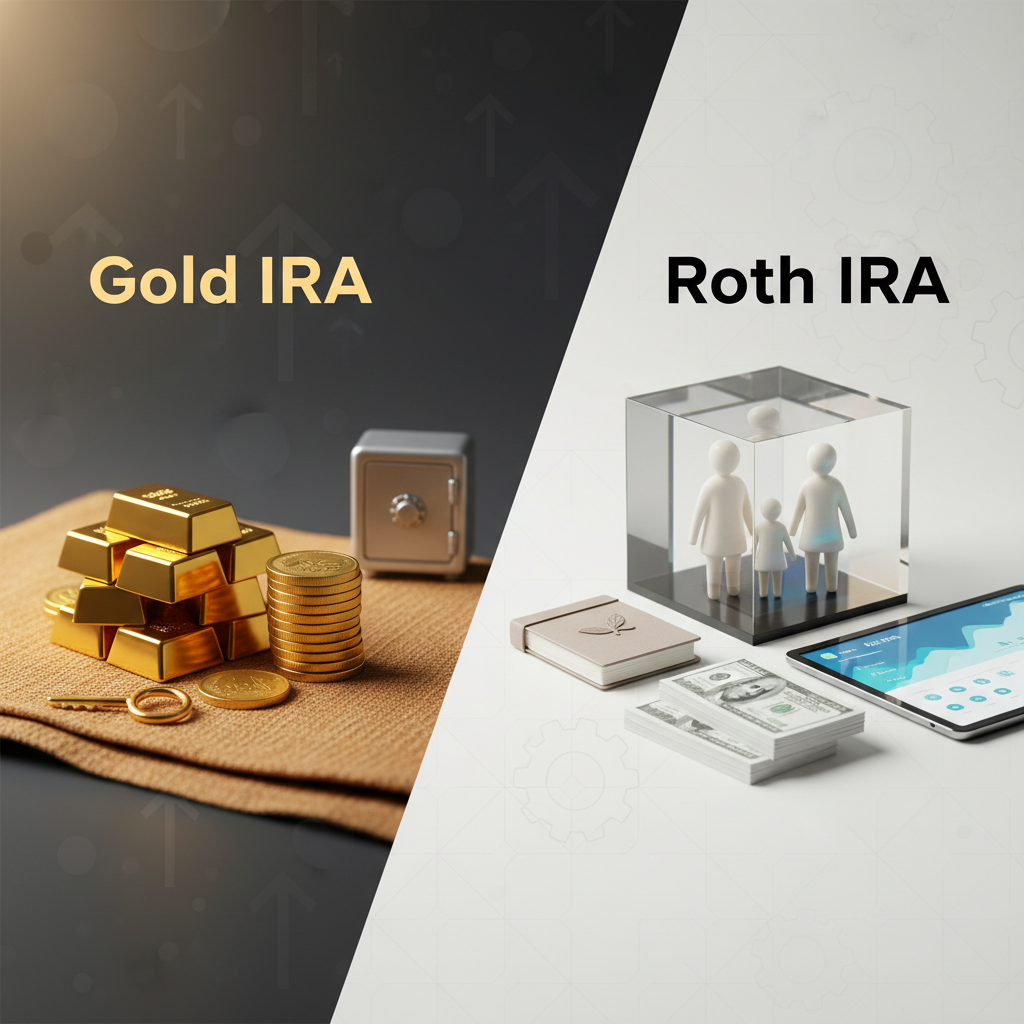
In the realm of retirement planning, investors often seek strategies to diversify their portfolios and protect their wealth from economic volatility. Two popular retirement vehicles, the Gold IRA and the Roth IRA, offer distinct advantages, particularly concerning tax treatment and asset classes. While both are powerful tools for long-term savings, understanding their fundamental differences is crucial for making informed investment decisions. This comprehensive guide from American Standard Gold will delineate the unique characteristics, benefits, and considerations of each, helping high-net-worth individuals, retirees, and families navigate their options for wealth preservation.
Table of Contents
- Key Takeaways (TL;DR)
- What is a Gold IRA?
- What is a Roth IRA?
- Primary Differences: Gold IRA vs. Roth IRA
- Tax Implications and Advantages
- Asset Classes and Diversification
- Contribution Limits and Eligibility
- Withdrawals and Distributions
- Why Consider a Gold IRA for Your Portfolio?
- Making the Right Choice for Your Retirement
- Frequently Asked Questions About Gold IRAs and Roth IRAs
Key Takeaways (TL;DR)
- A Gold IRA allows you to hold physical precious metals like gold, silver, platinum, and palladium within a tax-advantaged retirement account, offering a hedge against inflation and market instability.
- A Roth IRA is a retirement account funded with after-tax dollars, meaning qualified withdrawals in retirement are tax-free, but it typically holds traditional paper assets like stocks, bonds, and mutual funds.
- The primary distinction lies in their asset classes (physical precious metals vs. paper assets) and the timing of their tax advantages (tax-deferred growth in a Traditional IRA, tax-free withdrawals in a Roth IRA).
- While a Roth IRA cannot directly hold physical gold, it is possible to invest in gold-related assets like ETFs or mining stocks within a Roth IRA, though this does not provide direct ownership of physical metal.
- For direct ownership of investment-grade physical precious metals within a tax-advantaged structure, a Gold IRA is the appropriate vehicle.
What is a Gold IRA?
A Gold IRA, also known as a Precious Metals IRA, is a specialized self-directed Individual Retirement Account (IRA) that permits investors to hold physical precious metals as qualified investments. Unlike traditional IRAs that typically contain paper assets such as stocks, bonds, and mutual funds, a Gold IRA provides direct ownership of tangible assets. These assets, which must meet specific IRS purity standards, include investment-grade gold, silver, platinum, and palladium bullion from authorized mints and LBMA-approved refiners.
The primary appeal of a Gold IRA lies in its ability to offer portfolio diversification beyond conventional financial instruments. Historically, precious metals have demonstrated a low correlation with other asset classes, acting as a potential hedge during periods of economic uncertainty, inflation, and currency devaluation. This type of IRA functions similarly to a Traditional IRA in terms of tax deferral: contributions may be tax-deductible, and earnings grow tax-deferred until retirement distributions. Learn more about Gold & Silver IRA information.
What is a Roth IRA?
A Roth IRA is a type of individual retirement account that offers a distinct tax advantage: qualified withdrawals in retirement are entirely tax-free. This benefit stems from the fact that contributions to a Roth IRA are made with after-tax dollars, meaning you pay taxes on the money now, rather than later. This structure can be particularly appealing for individuals who anticipate being in a higher tax bracket during their retirement years.
Roth IRAs typically hold a wide array of traditional investment assets, including stocks, bonds, mutual funds, and exchange-traded funds (ETFs). While a Roth IRA cannot directly hold physical precious metals like a Gold IRA, investors can gain exposure to the gold market through gold-related securities, such as gold mining company stocks or gold ETFs. However, it is crucial to note that these are not direct ownership of physical gold and carry different risk profiles.
Primary Differences: Gold IRA vs. Roth IRA
The distinction between a Gold IRA and a Roth IRA is multifaceted, encompassing asset classes, tax treatment, and investment objectives. Understanding these core differences is paramount for strategic retirement planning.
What are the main asset types held in a Gold IRA compared to a Roth IRA?
The most significant difference lies in the eligible assets. A Gold IRA is specifically designed to hold physical, investment-grade precious metals. This includes gold, silver, platinum, and palladium bullion and coins that meet IRS purity standards (e.g., 0.995 fine for gold). These metals are stored in an IRS-approved depository, providing security and compliance.
Conversely, a Roth IRA typically invests in conventional financial instruments. These include publicly traded stocks, corporate and government bonds, mutual funds, and various exchange-traded funds (ETFs). While a Roth IRA can invest in gold-backed ETFs or mining company stocks, it cannot hold the actual physical metal. This distinction is critical for investors seeking the unique benefits of tangible asset ownership.
Tax Implications and Advantages
The tax treatment of contributions and withdrawals is a cornerstone difference between these two retirement vehicles.
How do the tax advantages of a Gold IRA compare to a Roth IRA?
A Gold IRA, when structured as a Traditional IRA, offers tax-deferred growth. This means that contributions may be tax-deductible in the year they are made, and your investments grow without being taxed annually. Taxes are only paid when you take distributions in retirement. This can be advantageous if you expect to be in a lower tax bracket during retirement.
A Roth IRA, by contrast, operates on an 'after-tax' contribution model. You contribute money that has already been taxed, and in return, all qualified withdrawals in retirement are completely tax-free. This includes both your contributions and any earnings. This structure is highly beneficial if you anticipate being in a higher tax bracket in retirement or if you desire tax-free income during your golden years.
Asset Classes and Diversification
Diversification is a key principle in sound investment strategy, and both IRAs contribute to it in different ways.
Can a Roth IRA hold physical gold?
No, a Roth IRA cannot directly hold physical gold or other precious metals. IRS regulations for Roth IRAs, like traditional IRAs, prohibit the direct holding of collectibles, which includes physical precious metals, with the sole exception being specific investment-grade bullion held in an approved depository. This exception is what defines a Gold IRA as a specialized self-directed IRA.
For investors seeking to diversify with physical assets, a Gold IRA provides the direct ownership and storage of tangible metals, offering a distinct form of diversification compared to paper assets. For instance, during periods of high inflation, such as the 1970s, gold prices soared, offering a stark contrast to equity market performance. According to the World Gold Council, gold has historically preserved purchasing power over the long term, averaging annual returns of approximately 10% over the last 50 years. This makes a gold investment a compelling choice for wealth preservation.
Contribution Limits and Eligibility
Both types of IRAs are subject to annual contribution limits set by the IRS, which can change periodically. For 2024, the contribution limit for IRAs (including both Gold IRAs and Roth IRAs) is $7,000, with an additional catch-up contribution of $1,000 for those aged 50 and over, totaling $8,000.
Eligibility for contributing to a Roth IRA is subject to income limitations. For 2024, if your Modified Adjusted Gross Income (MAGI) is above certain thresholds ($161,000 for single filers or $240,000 for married filing jointly), your ability to contribute directly to a Roth IRA may be phased out or eliminated. There are no such income restrictions for contributing to a Traditional IRA (which a Gold IRA typically is), though deductibility of contributions may be affected by participation in an employer-sponsored retirement plan.
Withdrawals and Distributions
Understanding the rules for withdrawals is crucial for retirement planning.
When can I withdraw from a Gold IRA or Roth IRA without penalty?
For both Gold IRAs (as Traditional IRAs) and Roth IRAs, penalty-free withdrawals typically begin at age 59½. Early withdrawals before this age may be subject to a 10% penalty, in addition to ordinary income taxes for Traditional IRA distributions. Roth IRAs have an additional rule: for qualified distributions to be tax-free, the account must have been open for at least five years, and the account holder must be 59½ or meet other specific criteria (e.g., disability, first-time home purchase).
Required Minimum Distributions (RMDs) generally apply to Traditional IRAs, including Gold IRAs, starting at age 73 (as of the SECURE Act 2.0). Roth IRAs, however, are exempt from RMDs for the original owner, offering greater flexibility in managing your retirement income and estate planning.
Why Consider a Gold IRA for Your Portfolio?
For high-net-worth individuals and those focused on long-term wealth preservation, a Gold IRA offers unique benefits that complement a diversified portfolio.
- Inflation Hedge: Precious metals, particularly gold, have historically served as a reliable hedge against inflation, maintaining purchasing power when fiat currencies decline.
- Crisis Protection: In times of geopolitical instability or economic crisis, gold often acts as a safe-haven asset, tending to appreciate when other markets falter.
- Portfolio Diversification: Adding physical precious metals can reduce overall portfolio volatility due to their low correlation with stocks and bonds.
- Tangible Asset Ownership: Unlike paper assets, a Gold IRA provides direct ownership of a physical, finite commodity, offering a sense of security and permanence.
American Standard Gold specializes in facilitating the establishment and management of investment-grade Gold IRAs. Our expert advisors guide clients through every step, from selecting authorized mints and LBMA-approved refiners to ensuring secure storage with IRS-approved depositories.
Making the Right Choice for Your Retirement
Deciding between a Gold IRA and a Roth IRA, or determining how to integrate both into your retirement strategy, depends on your individual financial goals, risk tolerance, and tax outlook. If your primary objective is tax-free growth and withdrawals in retirement, and you prefer traditional paper assets, a Roth IRA may be ideal. If, however, you seek to diversify with tangible assets, hedge against economic uncertainty, and benefit from the historical stability of physical precious metals within a tax-advantaged structure, a Gold IRA is an invaluable consideration.
Many sophisticated investors choose to utilize both types of accounts, leveraging the unique benefits of each to create a robust and resilient retirement portfolio. For personalized guidance on how a Gold IRA can fit into your comprehensive wealth preservation strategy, we invite you to connect with an expert advisor at American Standard Gold. Our advisory process is designed to provide tailored solutions for your unique financial landscape.
Frequently Asked Questions About Gold IRAs and Roth IRAs
What is the primary benefit of a Gold IRA?
The primary benefit of a Gold IRA is the ability to hold physical, investment-grade precious metals like gold and silver within a tax-advantaged retirement account, offering a hedge against inflation and market volatility through tangible asset ownership.
Can I convert a Roth IRA into a Gold IRA?
You cannot directly convert a Roth IRA into a Gold IRA in the same way you might convert a Traditional IRA. A Roth IRA holds traditional paper assets, and to invest in physical gold, you would need to establish a separate self-directed IRA (a Gold IRA) and then fund it, potentially through new contributions or a rollover from a Traditional IRA. You can, however, invest in gold-related securities within your Roth IRA, but this is not direct ownership of physical metal.
Are Gold IRAs and Roth IRAs both tax-advantaged?
Yes, both Gold IRAs and Roth IRAs offer tax advantages, but the nature of these advantages differs. A Gold IRA, typically structured as a Traditional IRA, provides tax-deferred growth and potentially tax-deductible contributions. A Roth IRA offers tax-free withdrawals in retirement, as contributions are made with after-tax dollars.
What types of precious metals are allowed in a Gold IRA?
A Gold IRA allows for investment in specific types of physical precious metals that meet IRS purity standards. These include gold (0.995 fine), silver (0.999 fine), platinum (0.9995 fine), and palladium (0.9995 fine) in the form of coins or bars from authorized mints and LBMA-approved refiners. Examples include American Gold Eagles, Canadian Gold Maple Leafs, and various eligible bullion bars.
How do I start a Gold IRA?
To start a Gold IRA, you typically need to work with a specialized custodian that handles self-directed IRAs and allows for physical precious metals. The process involves opening the account, funding it (via transfer, rollover, or contribution), selecting your investment-grade precious metals, and arranging for their secure storage at an IRS-approved depository. American Standard Gold's expert advisors can guide you through each step of this process. Contact us at (832) 210-1560 for a complimentary consultation.