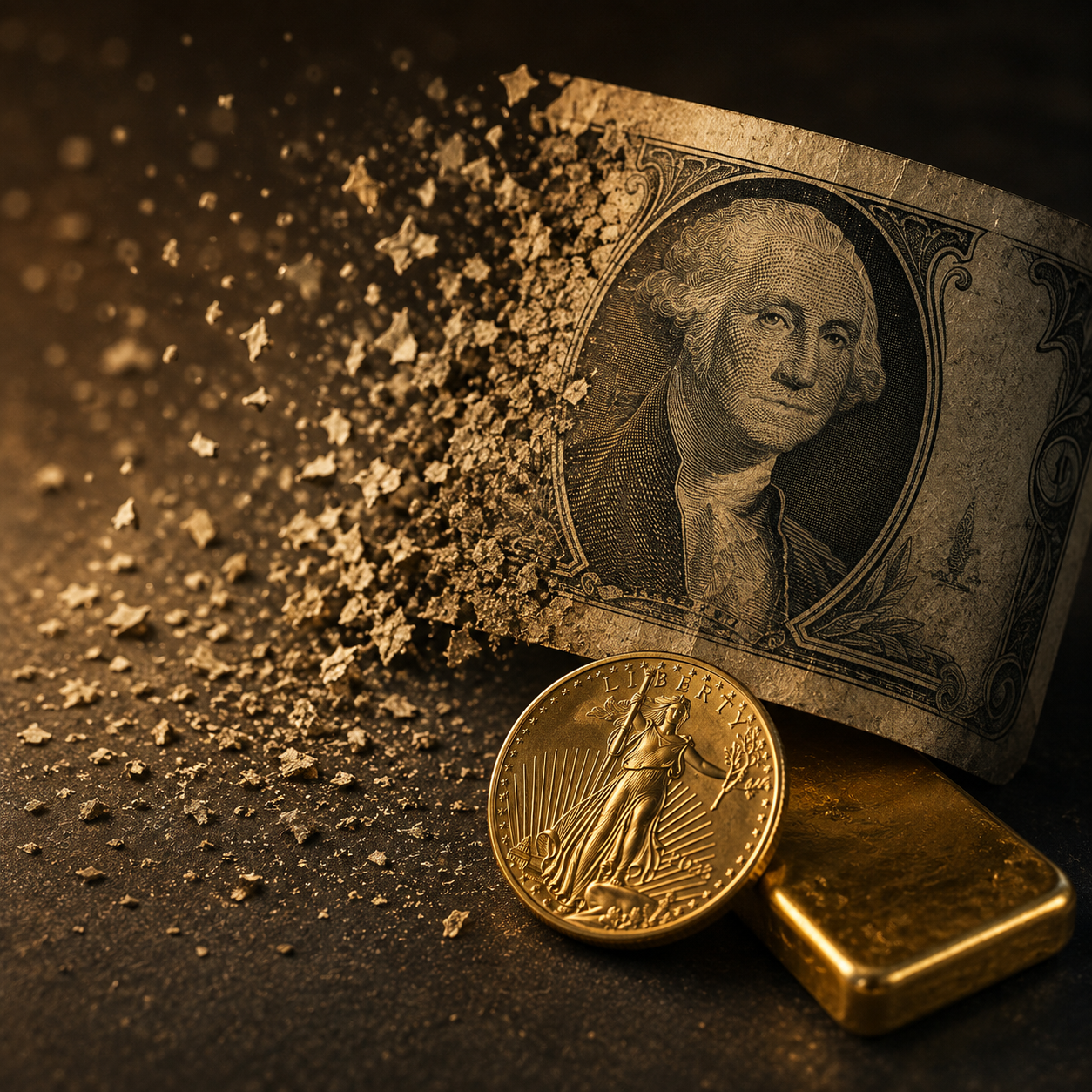
Why It's Important to Watch the Decay of the U.S. Dollar
TL;DR: The U.S. Dollar's purchasing power has steadily eroded over time due to inflation and monetary policy, making it critical for investors to understand this trend. Monitoring the decay of the U.S. Dollar is essential for safeguarding wealth, as a weakening dollar can diminish savings and investments. Historically, investment-grade precious metals like gold and silver have served as reliable hedges against currency depreciation, offering a tangible store of value when fiat currencies lose ground.
The U.S. Dollar has long been the world's primary reserve currency, a cornerstone of international trade and finance. However, its purchasing power has not remained constant. Over the past century, the dollar has experienced a significant decline in value, a phenomenon often referred to as the decay of the U.S. Dollar. This erosion is not a sudden event but a gradual process driven by various economic forces, primarily inflation and expansive monetary policies. For astute investors and families focused on wealth preservation, understanding this decay is not merely an academic exercise; it is a fundamental aspect of sound financial planning.
What Causes the U.S. Dollar to Decay?
Several interconnected factors contribute to the long-term decline in the U.S. Dollar's purchasing power. Inflation is arguably the most significant. The Federal Reserve, tasked with maintaining price stability, has a target inflation rate of 2% annually. While seemingly modest, this cumulative effect can be substantial over decades. For instance, an item costing $100 in 1970 would require approximately $780 today to purchase, illustrating an almost 87% loss in purchasing power over that period.
Monetary policy also plays a pivotal role. Quantitative easing, low interest rates, and increased money supply can dilute the value of existing currency. When the supply of dollars increases faster than the growth of goods and services, each dollar buys less. Fiscal policies, including government spending and national debt, further influence the dollar's strength. A rising national debt, currently exceeding $34 trillion, can create concerns about the government's ability to service its obligations, potentially undermining confidence in the currency.
How Does Dollar Decay Impact Your Savings and Investments?
The insidious nature of dollar decay means that your cash savings, if not invested wisely, are constantly losing value. A dollar saved today will buy less tomorrow. This impacts everything from retirement funds to everyday expenses. For investors, it means that returns on traditional assets, such as bonds or even certain stocks, might be eroded by inflation, leading to a lower real rate of return. This necessitates a strategic approach to portfolio construction, one that considers assets designed to preserve purchasing power.
Consider a scenario where an investor holds a significant portion of their wealth in cash or low-yield savings accounts. Over time, the purchasing power of that capital diminishes, making it harder to achieve long-term financial goals. This makes the decay of the U.S. Dollar a silent threat to financial security, particularly for those approaching or in retirement.
Why Are Precious Metals a Traditional Hedge Against Dollar Decay?
Historically, gold and other investment-grade precious metals have served as a reliable hedge against currency depreciation and inflation. Unlike fiat currencies, which can be printed at will, the supply of physical gold and silver is finite. This inherent scarcity, combined with their universal recognition as stores of value, makes them attractive during periods of economic uncertainty or currency weakness.
When the U.S. Dollar weakens, the price of gold, typically denominated in dollars, tends to rise. This inverse relationship helps to preserve wealth. For example, during periods of high inflation in the 1970s and early 2000s, gold prices saw significant appreciation, outpacing the decline in the dollar's purchasing power. The World Gold Council consistently highlights gold's role as a strategic asset for wealth preservation, particularly in times of economic instability.
American Standard Gold specializes in helping investors integrate physical precious metals into their portfolios, offering expert advice on why invest in precious metals to safeguard against currency decay.
What Role Do Gold and Silver IRAs Play in Wealth Preservation?
For many investors, a Gold & Silver IRA offers a tax-advantaged way to hold physical precious metals, such as gold, silver, platinum, and palladium, within a retirement account. This allows individuals to diversify their retirement savings beyond traditional paper assets, providing a direct hedge against the decay of the U.S. Dollar and potential market volatility.
Structuring a portion of your retirement portfolio with physical precious metals can offer a layer of protection that traditional stocks and bonds might not provide during periods of significant inflation or currency devaluation. Our expert advisors can guide you through the process, ensuring compliance with IRS regulations and helping you select the right investment-grade products from authorized mints and LBMA-approved refiners.
How Can Investors Monitor the Health of the U.S. Dollar?
Staying informed about the dollar's health involves tracking several key economic indicators:
- Inflation Rates: The Consumer Price Index (CPI) is a primary measure of inflation, indicating the rate at which the purchasing power of the dollar is eroding.
- Interest Rates: Decisions by the Federal Reserve regarding the federal funds rate can significantly impact the dollar's value. Higher rates generally strengthen the dollar, while lower rates can weaken it.
- National Debt and Fiscal Policy: Monitoring government spending and the national debt provides insight into potential future inflationary pressures.
- U.S. Dollar Index (DXY): This index measures the dollar's value against a basket of six major foreign currencies, offering a real-time snapshot of its relative strength.
- Geopolitical Events: Global events and the stability of other major economies can also influence the dollar's standing as a safe-haven currency.
By closely observing these indicators, investors can make more informed decisions about protecting their wealth from the ongoing decay of the U.S. Dollar. Our advisory process is designed to help you navigate these complexities.
Is the U.S. Dollar Losing its Global Reserve Status?
While the U.S. Dollar remains the dominant global reserve currency, there are ongoing discussions and some evidence suggesting a gradual shift. Countries like China and Russia have been actively seeking alternatives for international trade and reserves, promoting their own currencies or increasing their holdings of gold. According to the International Monetary Fund (IMF), the dollar's share of global foreign exchange reserves has seen a modest decline in recent years, though it still accounts for over 58% of allocated reserves.
This trend, while slow, underscores the importance of diversification for investors. Relying solely on a single currency, even one as powerful as the U.S. Dollar, carries inherent risks. Diversifying into investment-grade precious metals provides a strategic safeguard against potential future shifts in the global financial landscape and further mitigates the impact of the decay of the U.S. Dollar.
Conclusion: Protecting Your Wealth from Dollar Decay
The gradual decay of the U.S. Dollar is an undeniable economic reality that demands attention from serious investors. While the dollar remains a powerful currency, its long-term trajectory of diminishing purchasing power necessitates proactive wealth preservation strategies. Investment-grade physical precious metals, including gold, silver, platinum, and palladium, have historically proven to be effective hedges against inflation and currency devaluation.
At American Standard Gold, we are dedicated to providing expert advisory services to help you navigate these economic complexities. Our focus is on empowering you to protect and grow your wealth through tangible assets. We invite you to explore our product catalog or consider our sell-to-us program if you are looking to liquidate existing holdings.
Frequently Asked Questions About Dollar Decay
What does 'decay of the U.S. Dollar' mean?
The 'decay of the U.S. Dollar' refers to the gradual loss of its purchasing power over time, primarily due to inflation and expansive monetary policies. This means that a dollar today buys less than it did in the past.
How does inflation contribute to dollar decay?
Inflation, which is the general increase in prices and fall in the purchasing value of money, directly causes dollar decay. As prices rise, each dollar can purchase fewer goods and services, effectively reducing its value. The Federal Reserve's target inflation rate of 2% annually, while seemingly small, compounds over time to significantly erode purchasing power.
Are precious metals a good hedge against dollar decay?
Yes, investment-grade precious metals like gold and silver are widely considered a strong hedge against dollar decay. Their finite supply and intrinsic value mean they tend to retain or even increase in value when fiat currencies lose purchasing power due to inflation or economic instability.
What is the U.S. Dollar Index (DXY) and why is it important?
The U.S. Dollar Index (DXY) is a measure of the value of the U.S. Dollar relative to a basket of six major world currencies. It is important because it provides a real-time indicator of the dollar's strength or weakness in the global market, helping investors assess its health and potential for further decay.
How can I protect my retirement savings from dollar decay?
To protect retirement savings from dollar decay, investors often diversify their portfolios to include assets that are less susceptible to inflation and currency devaluation. This can include investment-grade physical precious metals held within a Gold & Silver IRA, which offers tax advantages while providing a tangible store of value. Consulting with an expert advisor can help tailor a strategy to your specific needs.
For a complimentary consultation to discuss how to protect your wealth from the decay of the U.S. Dollar, please contact us at (346) 680-5015 or email info@americanstandardgold.com.